Table of Contents
- What Professional Wedding Photo Editing Services Now Include
- Where AI Still Falls Short for Wedding Photos
- Manual vs. AI-Only vs. Hybrid Editing
- How to Evaluate Professional Wedding Photo Editing Services That Use AI
- Get Started With AI-Assisted Wedding Photo Editing
A single wedding can produce 400 to 800 images, from getting-ready shots through a reception that shifts from daylight to string lights. Editing all of it by hand takes days. Editing all of it with AI alone can be fast and still miss the moments that mattered most.
Neither extreme is the real answer.
Here’s what AI photo editing actually handles well in a wedding workflow, where it still falls short, and what that means for how professional wedding photo editing services operate today.
What Professional Wedding Photo Editing Services Now Include
Professional wedding photo editing services used to mean a human editor working through every image by hand: culling, color correction, retouching, and matching a consistent style across hundreds of frames. That’s still part of the picture, but it’s no longer the whole picture.
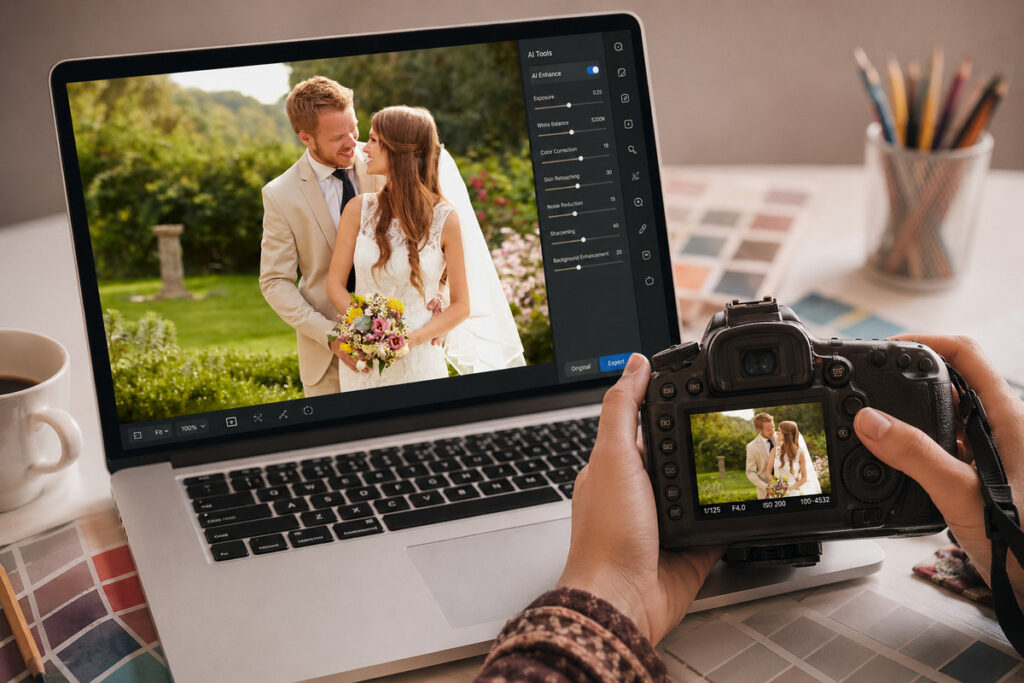
AI is now part of most working photographers’ process. According to VSCO’s Photographers and AI Industry Research Report, 88% of working photographers use AI in some part of their workflow, and 68% use it weekly or daily.1 Culling and editing automation are among the most common applications.
That shift means a modern wedding editing service isn’t choosing between “AI” and “a human editor.” It’s some combination of both, and the specifics of that combination are what actually determine the quality a couple gets back.
What AI Handles Well in Wedding Photo Editing
AI is genuinely good at a specific set of corrections, and wedding photography benefits from all of them. Exposure balancing across a bracketed set works reliably, whether it’s a backlit ceremony shot or a dim reception toast. White balance correction on standard daytime portraits is consistent and fast.
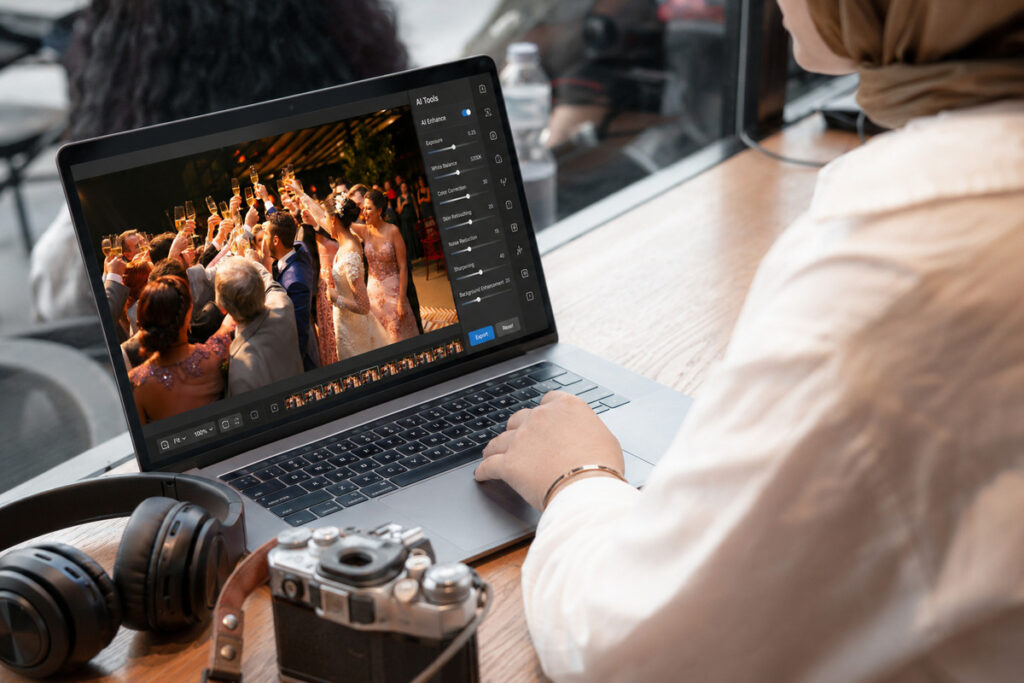
Batch color consistency matters more at wedding volume than almost anywhere else. Getting matching tone and color across 400 to 800 images from a single day, shot across changing light and multiple locations, is one of the clearest places AI editing saves real time.
HDR blending on a clean, standard shot, basic object removal like a stray cable or an exit sign in a reception hall, and perspective or lens correction round out what AI handles well without much oversight. None of this is in question. It’s the more delicate parts of a wedding gallery where AI needs help.
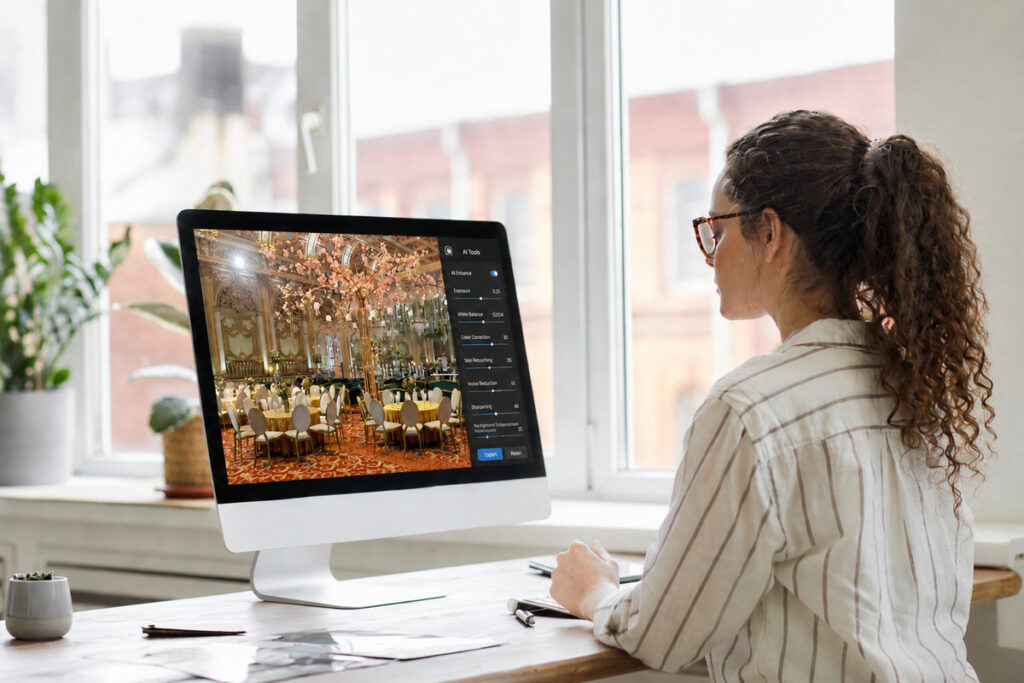
Picture three weddings booked back to back in peak season. With AI handling exposure, white balance, and batch color first, professional wedding photo editing services can save editors hours of repetitive work and keep galleries moving.
Where AI Still Falls Short for Wedding Photos
Skin tone and retouching subtlety is the clearest gap. A wedding gallery gets studied closely, by the couple, by their families, for years. An AI pass that over-smooths skin or shifts a skin tone slightly off is a mistake that shows up in a print hanging on someone’s wall, not just a thumbnail scrolled past once.
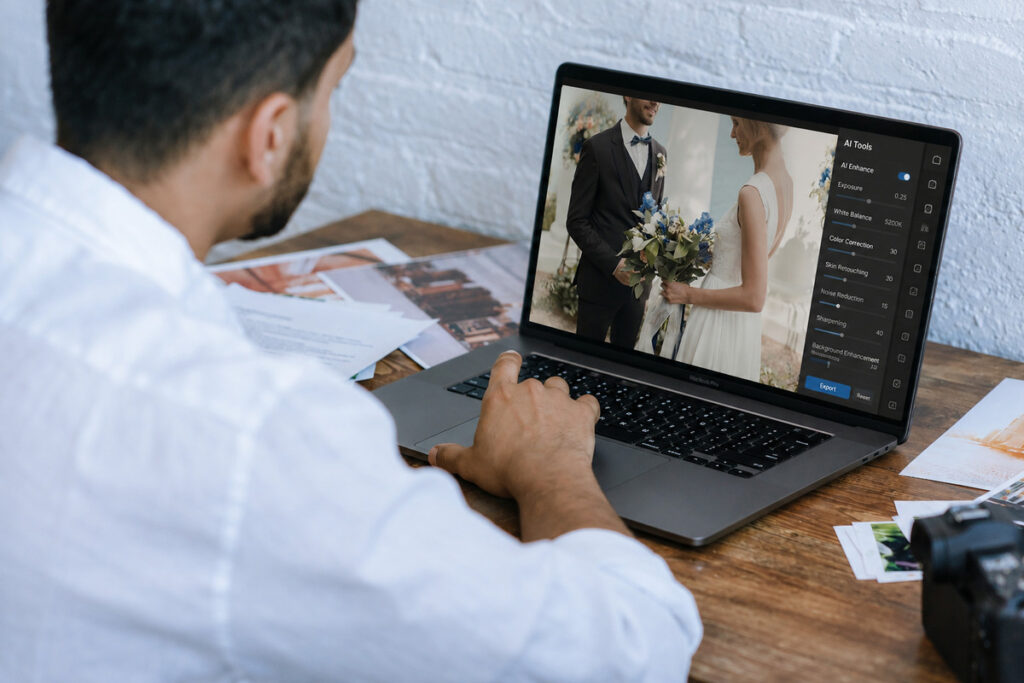
Mixed-light reception venues are another consistent problem. A dance floor lit by string lights, a DJ booth with colored uplighting, and a cake table under warm tungsten all in the same room need local adjustments that a single global correction won’t get right.
Candid, emotional moments carry their own risk. A processing pass tuned for technical correctness can flatten the exact expression or lighting quality that made a photo worth keeping in the first place. And matching one couple’s specific style consistently across getting-ready light, ceremony light, and reception light is a judgment call, not a setting.
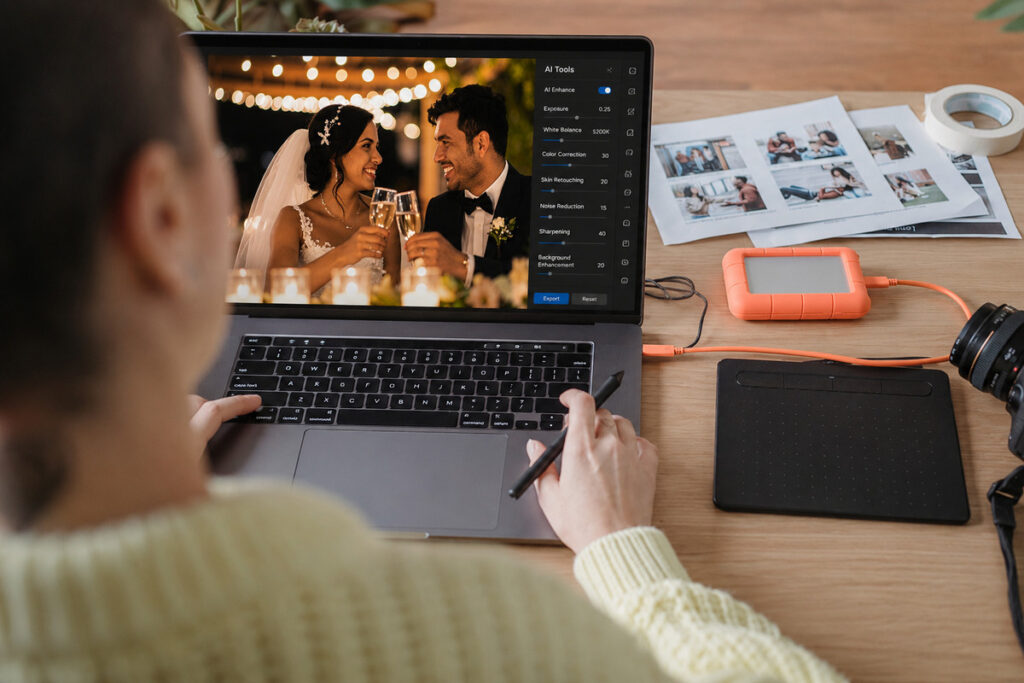
It’s worth naming why this matters more here than in most photo editing categories. A VSCO industry survey found that 42% of photographers worry specifically about losing creative control to AI.1 For wedding photography, where the entire product is built around one irreplaceable day, that concern is grounded in something real.
These aren’t rare cases. Every wedding moves through different lighting setups, and AI can still apply generic corrections that miss the couple’s style. That’s the gap professional wedding photo editing services still need human judgment to catch.
Manual vs. AI-Only vs. Hybrid Editing
| Factor | Fully Manual | AI-Only | Hybrid (AI + Human Review) |
|---|---|---|---|
| Turnaround on 400-800 images | Slow, days to weeks | Fast, often same-week | Fast, with review added |
| Consistency across a full gallery | Depends on the editor’s stamina | High on standard shots | High across all categories |
| Skin tone and retouching | Strong, but time-intensive | Inconsistent on close-ups | Reviewed before delivery |
| Mixed-light reception scenes | Handled case by case | Often needs a redo | Flagged and corrected |
| Cost | Highest | Lowest | Mid-range |
None of these three options is wrong for every studio. The trade-off is between speed, cost, and how much confidence a studio has that nothing slipped through before a gallery reaches the couple. For most studios marketing professional wedding photo editing services today, the hybrid column is where client expectations actually sit.
Focus on Photography
We'll Handle the Rest
Save time with a dedicated PhotoUp Coordinator.

What This Looks Like on an Actual Wedding Day
Take a typical Saturday: getting-ready shots start around 10 a.m. in natural window light, the ceremony runs at 4 p.m. under a mix of shade and direct sun, and the reception carries on past dark under string lights and a DJ booth with colored uplighting. That’s three lighting environments and one gallery.
Under an AI-only process, all three get the same kind of automated correction, tuned for whatever the tool’s model considers a typical exposure. The getting-ready shots and most of the ceremony images usually come back looking right. The reception is where it tends to fall apart, because that’s the one setting AI corrections are least reliable on.
A hybrid process runs the same AI pass across all three lighting environments, then routes the reception images and any close-up portraits through a review step before the gallery goes out. The couple never sees the difference in process. They just see a gallery that looks consistent from the first getting-ready shot to the last dance floor frame.
How to Evaluate Professional Wedding Photo Editing Services That Use AI
A few questions separate a service that’s actually built around AI and human review from one that’s just running everything through a tool and hoping for the best:
| Is there a human review step, and specifically what does that reviewer check before delivery? |
| How does style matching work across getting-ready, ceremony, and reception light within the same gallery? |
| What’s the turnaround at full wedding volume, not just on a sample batch of twenty images? |
| What’s the revision policy if a couple flags something after delivery? |
A service that can answer all four specifically, rather than with a general assurance that “AI handles it,” is more likely to have an actual process behind the marketing.
How PhotoUp Approaches Wedding Photo Editing With AI and Human Oversight
The same model that runs PhotoUp’s real estate editing work applies here. A PhotoUp Coordinator implements the AI tools handling the repeatable corrections, exposure, white balance, batch color, and HDR blending, and runs the human review step on the parts that need it: skin tones, mixed-light scenes, and style consistency across a full gallery.
Browse Top Dedicated
Real Estate Photo Editors
Ready-to-hire editors for real estate photo editing, and more.
This isn’t AI versus a human editor. It’s AI doing the volume work reliably, with a person checking the specific places where a wedding gallery can’t afford a mistake. That distinction is what separates a genuine hybrid process from a studio that’s just relabeled the same unreviewed AI output as professional wedding photo editing services without actually changing anything behind the scenes.
Get Started With AI-Assisted Wedding Photo Editing
A PhotoUp Coordinator sets up and runs this process for you:
- Implements AI editing for the corrections it handles reliably, at full wedding volume
- Runs a human review step on skin tones, mixed-light scenes, and style matching
- Keeps a couple’s specific style consistent across every stage of the day
- Manages turnaround so a full gallery doesn’t wait on a single editor’s schedule
Focus on Photography
We'll Handle the Rest
Save time with a dedicated PhotoUp Coordinator.
Why work with PhotoUp: a dedicated Coordinator who implements and QAs the process, not a black-box tool you’re trusting to get skin tones and reception lighting right on its own, backed by professional photo editing experience since 2011.
How to get started:
- Talk to a PhotoUp Coordinator about your current editing process and typical gallery size
- Get a walkthrough of how the AI pass and human review step would work together for your style
- Run one wedding gallery through the process before committing to a full season
Hire a Production Coordinator to run your AI editing pipeline.
Related Articles:
- Wedding Photo Editing: What Happens After the Shoot?
- Why Photographers Need a Production Coordinator for AI Photo Editing Workflows
- What’s Included in Wedding Photo Editing Services?
- How Wedding Photo Editing Helps You Deliver Stunning Galleries
- How to Choose the Right AI Photo Editing Software for Your Workflow
References: