Table of Contents
- Why Editing Capacity Is What Actually Caps Your Bookings
- What Professional Wedding Photo Editing Services Actually Do
- How Outsourced Editing Turns Into More Bookings and Revenue
- How Do You Choose the Right Wedding Photo Editing Partner?
- Editing Service vs. Freelancer vs. In-House vs. Full Business Support
- What Happens to the Rest of the Business While Editing Is Handled
- Build a Wedding Photography Business That Scales From Booking to Delivery
You booked six weddings this month, which should feel like a win. Instead, three galleries are overdue, a bride is asking for a delivery update you don’t have, and the inquiry that came in last Tuesday still hasn’t gotten a reply because there’s no time left in the day for it.
The bookings aren’t the problem. The editing queue is.
This is where photo editing services for wedding photographers change the math. Below is what these services actually do, what they cost, how to evaluate one, and how outsourcing fits into a broader plan for growing a studio past the ceiling that editing time puts on it.
Why Editing Capacity Is What Actually Caps Your Bookings
Every wedding photographer eventually hits the same wall: the studio can shoot more weddings than it can edit. The average wedding photographer spends 10 to 15 hours editing a single event, and that’s before culling, revision rounds, and the inevitable rush job when a couple wants their gallery for an anniversary.
That workload adds up fast. Post-processing is one of the biggest contributors to photographer burnout, especially during peak wedding season when editing hours quickly stack up.
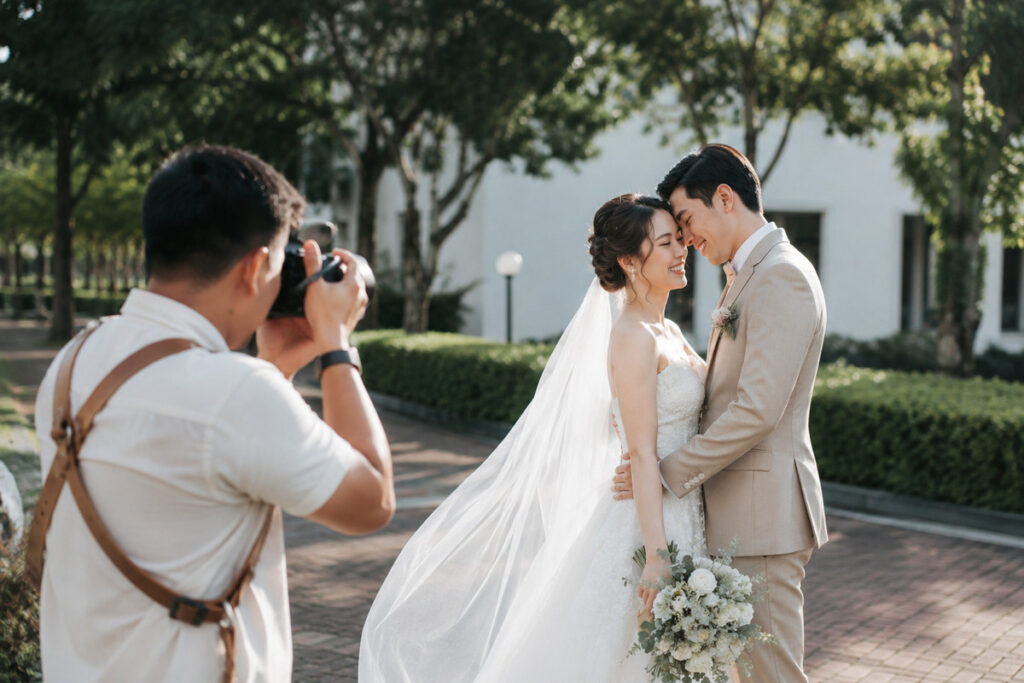
The bottleneck isn’t talent or demand. It’s hours in the day. A studio that wants to book more weddings without burning out its owner needs a different relationship with editing entirely, not just a faster way to do it alone.
Peak season makes the math worse. A photographer editing three weddings in a single month is looking at 30 to 45 hours of post-production on top of shooting, client communication, and the marketing that keeps the next booking coming in. Something on that list gets shortchanged, and it’s usually either sleep or the inquiry that came in three days ago and still hasn’t gotten a reply.
What Professional Wedding Photo Editing Services Actually Do
A wedding photo editing service isn’t a single feature bolted onto your workflow. It’s a production partner that takes a full gallery, from RAW files to a finished, client-ready set of images, off your desk.
That typically includes:
| Culling support to narrow thousands of raw images down to your final deliverable count |
| Color and exposure correction across ceremony, reception, and portrait lighting so the gallery reads as one consistent day |
| Style-matched editing trained on your presets or sample galleries, so the final images look like your work, not a generic template |
| Retouching for the requests every wedding brings, like stray hairs, blemishes, and background distractions |
| Turnaround guarantees, usually ranging from a few days to two weeks depending on the service and package |
| Delivery-ready output, formatted and organized for the gallery platform you already use |
The distinction that matters here: photo editing services for wedding photographers are trained to match your standards, not apply a one-size-fits-all look.

Most services structure pricing one of two ways: per-image rates that scale with volume, or a flat monthly plan for studios shooting multiple weddings a month. Per-image pricing suits a studio still testing whether outsourcing fits their workflow. A monthly plan tends to make more sense once editing volume is predictable enough to budget around.
How Outsourced Editing Turns Into More Bookings and Revenue
Reclaiming editing hours only matters if those hours turn into something. For most studios, they turn into capacity, and capacity turns into revenue.
The broader small business data supports that. Businesses that outsource at least one function grow revenue 15% faster on average than those that keep every function in-house. Meanwhile, 63% of small business owners say outsourcing gives them significantly more time to focus on business growth.1
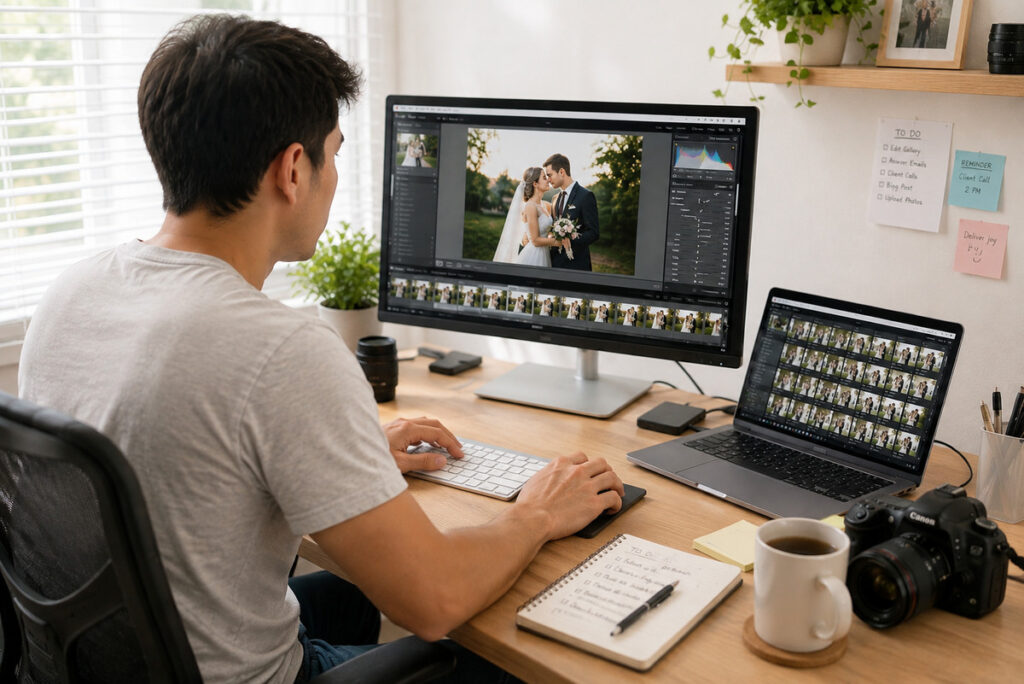
For a wedding studio, the math is simple. Editing a gallery yourself takes 10 to 15 hours. With photo editing services for wedding photographers, that workload can often be reduced to a 1- to 2-hour review and approval.
That’s 8 to 13 hours saved per wedding. Across six weddings in a month, that’s the equivalent of reclaiming an entire workweek—time you can spend meeting prospects, following up on inquiries, or booking more weddings.
The opportunity is growing, too. The wedding photography market is projected to reach $6.85 billion by 2035, with rising wedding budgets giving couples more room to invest in premium photography.2 For many studios, demand isn’t the challenge. Capacity is.
Focus on Photography
We'll Handle the Rest
Save time with a dedicated PhotoUp Coordinator.

Faster gallery delivery also strengthens referrals. Couples are most excited to share their experience soon after the wedding, and delivering a polished gallery quickly keeps that momentum going while the event is still fresh in everyone’s mind.
One final point: outsourcing only works when quality stays consistent. If every gallery needs extensive rework, the time savings disappear. That’s why choosing the right editing partner matters just as much as deciding to outsource.
How Do You Choose the Right Wedding Photo Editing Partner?
Not every editing service is built for wedding work, and not every wedding studio needs the same thing from one. A few criteria separate a partner worth keeping from one you’ll cancel after a season:
- Style-matching process: does the service train on your actual galleries and presets, or apply a generic look you’ll have to fix
- Turnaround guarantees: what’s the standard delivery window, and what happens during your peak months
- Revision policy: how requests get submitted, tracked, and resolved without a string of back-and-forth emails
- Consistency across editors: whether the same standards apply if your gallery is split across multiple editors on the team
- Scalability: whether the service can absorb a heavier volume during wedding season without turnaround slipping
- Security and file handling: how RAW files are stored, backed up, and protected during transfer
A useful gut check is to ask a prospective service how they’d handle a wedding with mixed lighting across five different scenes in a single day. Their answer quickly reveals whether they understand the unique demands of wedding editing or simply apply a generic editing workflow.
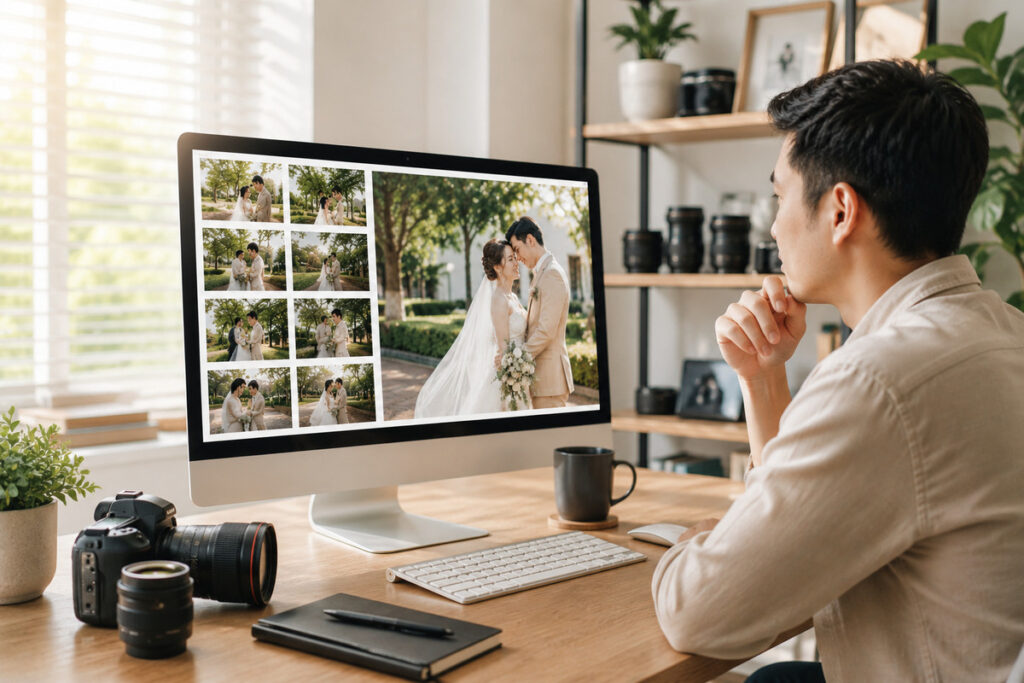
It’s also worth asking how revisions are handled. Every wedding photographer occasionally needs small adjustments, and a clear, hassle-free revision process signals a service that’s built for long-term partnerships. If every revision turns into a negotiation, it’s a preview of the kind of friction you can expect during your busiest wedding season.
Editing Service vs. Freelancer vs. In-House vs. Full Business Support
Editing services solve the editing bottleneck. But editing is only one piece of what actually caps how much a studio can grow. Here’s how the main options compare when you’re deciding what to hand off:
| Option | Solves | Doesn’t Solve |
|---|---|---|
| Self-editing | Full creative control | Caps how many weddings you can realistically book |
| Per wedding freelancer | Extra editingg capacity during peak season | Rarely learns your specific standards long-term |
| Dedicated editing service | Consistent, style-matched editing at scale | Booking, client communication, and marketing still fall on you |
| Editing service + Coordinator | Editing, delivery tracking, and client communication working together | Requires upfront onboarding of your standards |
Editing services and Coordinators aren’t competing solutions. One handles the images; the other handles everything around them, from coordinating the editing relationship to keeping the booking pipeline moving. Studios that pair both get the fullest picture of what outsourcing can actually do for growth.
Most studios don’t start at the last row of that table. A common path is testing photo editing services for wedding photographers for a season, confirming the quality and turnaround hold up, and then layering in coordination support once the editing side is running smoothly. There’s no requirement to solve every bottleneck at once.
What Happens to the Rest of the Business While Editing Is Handled
Solving the editing bottleneck exposes the next one. Once a gallery isn’t eating 10 to 15 hours of your week, someone still needs to manage the relationship with your editing service, track delivery dates across every wedding in the queue, and keep new inquiries from going cold while you’re behind the camera.
That’s a coordination problem, and it’s not one editing service is built to solve. Editing partners are trained to produce a consistent gallery. They’re not managing your calendar, following up on the lead from a bridal show, or making sure a couple’s revision request doesn’t sit in an inbox for a week.

It’s the kind of work a Production Coordinator and Growth Coordinator are trained to own. And it’s the difference between outsourcing editing as a one-off fix and building a business that actually runs on a system.
Build a Wedding Photography Business That Scales From Booking to Delivery
PhotoUp’s photo editing services for wedding photographers include dedicated Production and Growth Coordinators who provide trained, ongoing support instead of a task list handed to a freelancer.
Production Coordinator support includes:
- Coordinating editing requests and style notes with your editing team
- Tracking delivery schedules across every wedding in the queue
- Managing revision rounds so requests get logged and resolved
- Communicating gallery status updates so couples aren’t left wondering
- Supporting quality assurance with a second set of eyes before delivery
Focus on Photography
We'll Handle the Rest
Save time with a dedicated PhotoUp Coordinator.
Growth Coordinator support includes:
- CRM and lead management so no inquiry goes unanswered
- Inquiry follow-up that keeps prospective couples engaged through a long booking cycle
- Vendor and referral relationship management
- Social media and email marketing coordination
- Administrative support for contracts, invoicing, and client retention
Every Coordinator is trained across a full role, not a single task, and built to work alongside the AI-powered editing tools already reshaping wedding photography production. Studios can start with one Coordinator and add another as the business grows, the same way they’d bring on their next employee.
How to get started:
- Share where your workflow feels most stretched: editing, production, growth, or all three
- Get matched with a Coordinator trained for that function
- Onboard your standards, presets, and preferences once
- Hand off the work and get back to shooting
Scale your wedding photography business with dedicated support today!
Related Articles:
- How Wedding Photo Editing Helps You Deliver Stunning Galleries
- Virtual Assistant vs. Employee for Photographers: Which Is Better?
- When Should a Real Estate Photographer Hire a Virtual Assistant?
- Why Real Estate Photography Businesses Need a Virtual Assistant
References: