Table of Contents
- Why Marketing Keeps Sliding to the Bottom of the List
- What a Marketing Agency Actually Offers
- Is a Marketing Agency Worth It for a Solo or Small Studio?
- Marketing Agency vs. Growth Coordinator: Side-by-Side
- Find the Right Marketing Support for Your Studio
Photographers rarely lose business over photo quality. They lose it when a lead goes three days without a reply, or a neglected CRM lets a repeat client slip to whoever followed up first.
That’s not a marketing problem. It’s an ownership problem.
Most photographers reach a point where marketing needs a dedicated owner, not another task squeezed between shoots. That’s when the marketing agency vs in house marketing decision comes into play: hire an outside agency, or bring in a Growth Coordinator trained specifically for a photography business.
Why Marketing Keeps Sliding to the Bottom of the List
Marketing rarely gets neglected because photographers don’t care about it. It gets neglected because it’s the only part of the job with no deadline attached to it. A gallery has to go out by Friday. A lead follow-up does not, so it waits, and then it goes cold.
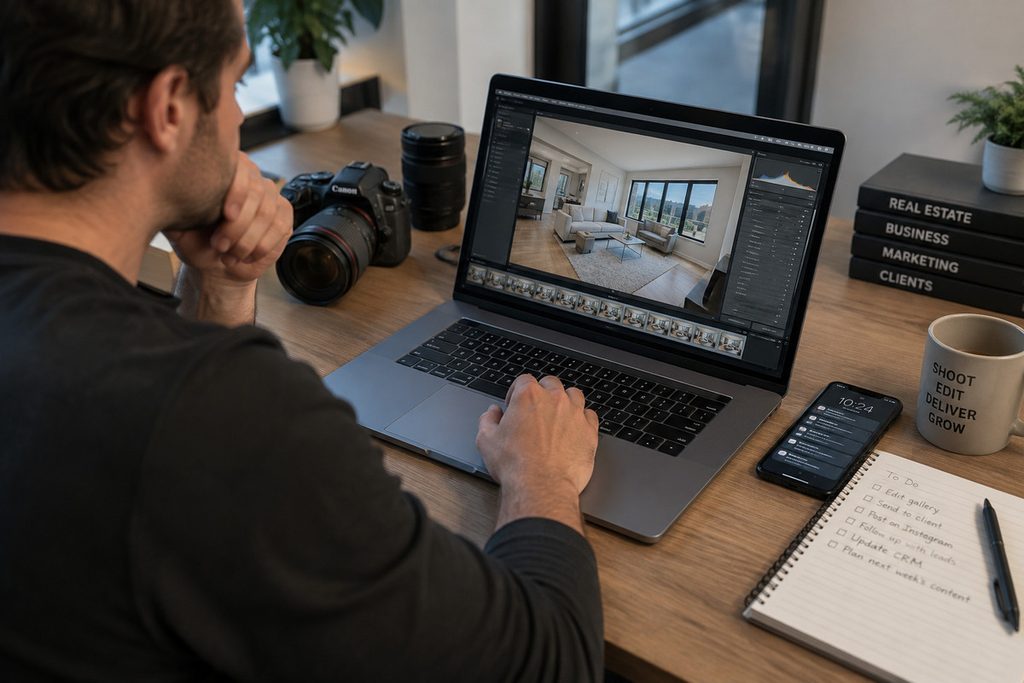
Small business owners spend roughly six hours a week on social media alone: planning content, scheduling posts, responding to comments, checking what’s working.1 That’s before CRM upkeep, email follow-up, or actually planning a campaign around a slow season. For a solo photographer already working weekends, six hours is most of a shooting day.
Money follows the same pattern. Most small businesses spend between $200 and $2,000 a month on social media marketing, often without a clear strategy behind the spend.1 It’s enough to feel like something is happening. It’s rarely enough to know whether it’s working.
What a Marketing Agency Actually Offers
In the marketing agency vs in house marketing decision, an agency brings structure a solo photographer usually can’t build alone: content calendars, ad management, analytics dashboards, and a full team instead of one overloaded person. For a studio with the budget and volume to justify it, that structure has real value.

The gaps show up in three places.
Specialization: most agencies work across industries. They know marketing broadly, not real estate photography specifically, so they’ll spend the first month or two learning your business, your clients, and what a good listing photo package even looks like. You’re paying to onboard them.
Cost at your scale: standard small business retainers for combined channels (social, content, some strategy) run $2,500 to $5,000 a month, with $500 to $2,500 for social media management alone.2 For a studio doing $8,000 to $15,000 a month in revenue, that’s a significant slice going to marketing before it’s proven out.
Commitment: a 90-day initial commitment with a 30-day cancellation window has become the standard structure in 2026.2 That’s reasonable by industry norms, but it still means three months of spend before you get a clear read on results.
None of this makes an agency a bad option. It makes it a specific one: built for a business with enough volume and budget to make broad expertise worth the ramp-up cost.
Is a Marketing Agency Worth It for a Solo or Small Studio?
Run the math at photographer scale and the answer depends almost entirely on what you’re trying to fix.

If you need strategy, an agency’s broad expertise can be worth the cost. If you already know what works but lack time to execute it, agency-level strategy may be more than you need.
For most photographers, the marketing agency vs in house marketing challenge comes down to bandwidth. A generalist agency may not understand real estate photography workflows, agent relationships, and repeat-client follow-up from day one.
Focus on Photography
We'll Handle the Rest
Save time with a dedicated PhotoUp Coordinator.

What a Growth Coordinator Offers: In-House-Level Support Without the In-House Hire
A Growth Coordinator is a dedicated team member trained specifically around a photography business’s growth needs, not a freelancer juggling multiple clients or a generic virtual assistant. It works more like an in-house marketing hire, without the salary, benefits, and management overhead of employing one.
The role covers:
| CRM setup and management, so leads and repeat clients don’t fall through gaps between shoots |
| Marketing and social media, kept consistent even during your busiest weeks |
| Client communication on the relationship side: responding to inquiries, nurturing leads, following up before a prospect goes cold |
| AI-powered marketing and CRM automation, run and checked by the Coordinator rather than left unsupervised |
That distinction matters as AI takes on more marketing tasks. AI can draft content, automate follow-ups, and manage CRM workflows, but it still needs someone to oversee the output and make judgment calls, like when a lead needs a personal response instead of an automated one.
Browse Top Dedicated
Real Estate Photo Editors
Ready-to-hire editors for real estate photo editing, and more.
A Growth Coordinator fills that role without replacing strategy. It gives photographers a third option between outsourcing marketing to a generalist agency and handling everything themselves: a dedicated person trained on the business who owns the function without the agency ramp-up or retainer minimums.
Marketing Agency vs. Growth Coordinator: Side-by-Side
| Marketing Agency | Growth Coordinator | |
|---|---|---|
| Typical monthly cost | $2,500–$5,000 for multi-channel work | Set monthly rate, scaled to a single dedicated team member |
| Real estate photography specialization | Learned during onboarding | Trained on it from day one |
| Contract structure | 90-day minimum standard, 30-day cancellation after | No agency-style lock-in |
| Day-to-day communication | Account manager, often shared across clients | One point of contact who knows your business |
| Scope of ownership | Executes the strategy they’re hired for | Owns CRM, content, and relationship follow-up as one connected function |
| AI implementation | Varies by agency | Trained specifically to run AI tools with human review built in |
How to Decide Which One Fits Your Studio
A few questions cut through most of the decision faster than a pros-and-cons list.
Do you need strategy, or do you need someone to run what you already know works?
If you’re unsure what your marketing should even look like, an agency’s broad expertise is worth paying for. If you already know (post consistently, follow up on leads within a day, keep the CRM current) and it’s just not happening, that’s an execution problem, and it’s the one a Coordinator solves.
What does your revenue support right now?
A $3,000-to-$5,000 monthly retainer makes sense at a certain volume. Below that, a dedicated Coordinator working within a smaller, set monthly cost is usually the more realistic starting point.
How much do you want to manage the manager?
Agencies typically report through an account manager who may be splitting time across several clients. A Coordinator works day-to-day inside your specific business, closer to an in-house marketing hire than an outside vendor, which usually means less translation and fewer status meetings.
None of these questions has a universally right answer. They do point most solo and small-studio photographers toward the same conclusion: the earliest marketing problem is rarely a strategy gap. It’s that nobody owns the follow-through.

That’s the gap a Growth Coordinator fills in the marketing agency vs in house marketing decision.
Find the Right Marketing Support for Your Studio
If bookings are steady but your marketing keeps losing to whatever’s due today, a Growth Coordinator gives you a dedicated team member who owns:
| CRM setup and pipeline management |
| Marketing and social media, maintained consistently |
| Client communication and lead nurturing |
| AI-powered marketing and CRM automation, with a person checking the output |
Why work with a PhotoUp Coordinator? Every Growth Coordinator is trained specifically for real estate photography businesses, not marketing in general. You get one dedicated point of contact instead of a rotating account team, and an AI-plus-human workflow where automation handles the repetitive work while your Coordinator makes the calls that need a person.
Focus on Photography
We'll Handle the Rest
Save time with a dedicated PhotoUp Coordinator.
How to get started:
- Talk through what’s currently falling through the cracks, whether that’s follow-up, content, or both
- Get matched with a Growth Coordinator trained on real estate photography businesses like yours
- Have your CRM, content calendar, and lead follow-up running within the first two weeks
Discover which Coordinator fits your studio.
Related Articles:
- CRM for Photographers: What It Does and Why Most Studios Outgrow a Spreadsheet
- What Can a Photography Coordinator Take Off Your Plate?
- What Professional Photo Editing Looks Like in the Age of AI
- Why Photographers Need a Production Coordinator for AI Photo Editing Workflows
- What Does a Virtual Assistant for Photographers Do?
References: